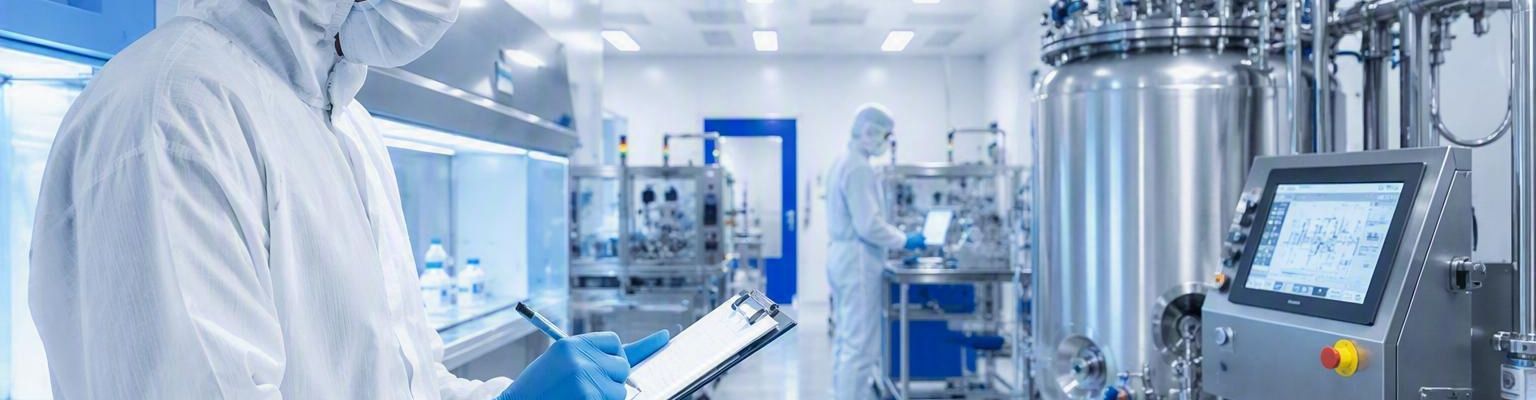
Cleanroom Supplies: Your Questions Answered by a Contamination Control Expert
Introducing Josh Bowman, Director of Operations at Myriad Industries and subject matter expert on cleanrooms.
Josh has more than 23 years of experience in cleanroom operations and critical environments, supporting customers across the High-Tech, Pharmaceutical, Medical Device, Biotech, Semiconductor, Mission Critical, and Government sectors. Since entering the cleanroom industry in 2003, Josh has built and led cleanroom operations teams, developing deep expertise in contamination control, quality systems, compliance, and operational excellence. Today, as Director of Operations at Myriad Industries, Josh serves as the company's primary cleanroom subject matter expert, providing technical guidance and operational leadership to help customers maintain the highest standards of cleanliness, compliance, and performance.
An empty cleanroom, running properly, stays clean on its own. The filters do their work, the air moves in one direction, the pressure differentials hold. Nothing inside is generating contamination, because there is nothing inside.
Everything that can go wrong walks through the door. Personnel is the single largest contamination source in almost every classified environment, and supplies are second.
That makes cleanroom supplies a contamination control decision, not just a purchasing one. Here, Josh Bowman, contamination control subject matter expert at Myriad Industries, answers the questions we hear most, from how ISO classification actually works to why the tacky mat at your entrance may be adding contamination rather than removing it.
Cleanroom Foundations
What exactly is a cleanroom, and how is it different from a clean industrial space?
A cleanroom is an engineered contamination control system. It uses HEPA or ULPA filtration and laminar airflow to keep airborne particles below a defined limit. It controls bioburden, temperature, humidity, and room pressure to meet specified standards under ISO 14644. A clean industrial space does not do this.
The HVAC is what makes the difference. Filters sit in the ceiling, air moves downward through the space in a single direction, and return vents low on the walls draw it out to sweep particles away rather than letting them circulate. Room pressure is deliberately managed so the cleanest area is held at positive pressure relative to everything around it, controlling which way air travels when a door opens.
Simply put, a cleanroom is classified, certified, and validated. A clean space may be spotless and well maintained, but without the filtration, the airflow design, and the documented validation behind it, it is not a cleanroom.
How are cleanrooms classified under ISO 14644?
ISO cleanroom classifications run from ISO 1 to ISO 9, based on the maximum concentration of airborne particles allowed in a cubic meter of air at specified particle sizes. The lower the number, the cleaner the environment. Each step down the scale represents roughly a tenfold reduction in permitted particles.
The table below shows the limits at 0.5 µm, the size most commonly referenced, alongside the older US Federal Standard 209E classes many facilities still use in conversation.
|
ISO class |
Max particles ≥0.5 µm per m³ |
FS209E equivalent |
Typical use |
|
ISO 3 |
35 |
Class 1 |
Advanced semiconductor lithography |
|
ISO 4 |
352 |
Class 10 |
Semiconductor fabrication |
|
ISO 5 |
3,520 |
Class 100 |
Aseptic filling, cell and gene therapy |
|
ISO 6 |
35,200 |
Class 1,000 |
Support areas to aseptic processing |
|
ISO 7 |
352,000 |
Class 10,000 |
Sterile compounding, device manufacture |
|
ISO 8 |
3,520,000 |
Class 100,000 |
Packaging, assembly, washroom, autoclave areas |
|
ISO 9 |
35,200,000 |
Room air |
Buffer and transition zones |
ISO 1 and ISO 2 are defined only at smaller particle sizes and are not listed here.
The practical gap between neighboring classes is larger than the numbers suggest. ISO 7 permits ten times fewer particles than ISO 8, and reaching it means more air changes per hour, tighter gowning and more rigorous cleaning, not just a better filter. Between ISO 5 and ISO 8 the difference is a thousandfold.
“You can have a really clean, controlled environment, but if it's not classified, it's not a cleanroom.”
Which class you need is determined by the sensitivity of your process, the risk profile of your product, and the regulations that apply to it, established through formal contamination risk assessment.
Standards, regulations and documentation
Which industries rely on cleanrooms, and how do their requirements differ?
Pharmaceuticals, biotechnology, medical devices, and semiconductors are the largest users, but what they are controlling for varies significantly, which in turn shapes the cleanroom supplies each one needs.
A semiconductor fab and an aseptic filling suite might both run at ISO 5, yet they are solving different problems. The fab is focused almost entirely on particulates at very small sizes, plus electrostatic discharge; it controls temperature and humidity tightly for process and metrology reasons rather than microbial ones. A pharmaceutical filling suite has to meet the same particle count and then satisfy limits on viable organisms measured in colony-forming units per plate, with pressure and humidity monitored and documented throughout.
Medical device requirements sit largely on product risk. Where nothing is implanted or ingested, ISO 7 or ISO 8 is often sufficient to control surface contamination. Cell and gene therapy, aerospace, optics, cannabis processing and food production are all adopting classified environments as well, generally driven by product quality rather than regulation.
Which standards and regulations govern cleanrooms in North America?
ISO 14644 is the standard. It is international; it defines classification and monitoring, and it applies regardless of sector. Regulation sits separately and depends on what you make: in the US, FDA current good manufacturing practice requirements, plus USP 797 and 800 for pharmacy compounding. Many facilities also build to EU GMP Annex 1.
That last point surprises people. Annex 1 is European, but it is the most stringent framework in general use and it has been widely adopted well beyond the EU. Companies selling internationally tend to design to the strictest requirement rather than the local minimum, on the logic that meeting Annex 1 makes satisfying the FDA straightforward.
Josh separates the three cleanly:
"ISO tells you how clean the air is. FDA cGMP tells you how you must operate to consistently produce a safe product. EU GMP Annex 1 tells you how to build a comprehensive contamination control strategy for sterile manufacturing."
Other jurisdictions (UK, Japan, Australia) maintain their own regulatory bodies, but the pattern holds. Build to the highest bar, and the rest generally follows.
What documentation should you look for when sourcing cleanroom supplies?
Certificates of conformance or analysis, sterility validation or gamma irradiation certification where relevant, lot traceability, and particulate and extractables data. On the supplier side, look for ISO 9001 quality management certification, or ISO 13485 where medical devices are involved.
The requirement is not simply that a product was clean when it was made. It is that cleanliness was maintained and evidenced from the point of manufacture, through the supply chain, to arrival at your facility — and that you can show it. Regulators do not accept assurance in place of documentation.
This is where a distributor either earns its place or becomes a liability. Myriad Industries is asked for validation paperwork constantly, and for supplier qualification forms almost as often, which is why we only work with vendors who can produce them. If a product cannot be evidenced, an inspector will treat it as unproven, and the burden of correcting that falls on you rather than on whoever supplied it.
What are the most common compliance mistakes?
The clear leader is using products that were never certified for cleanroom use: consumables that shed fibers or generate particles because nothing in their manufacture was designed to stop them.
Other common mistakes include:
- Poor inventory control and missing lot traceability
- Bringing cardboard into controlled areas: after people, it is one of the most significant contamination sources in any cleanroom
- Storing materials in areas that are themselves uncontrolled
- Failing to verify supplier quality documentation, or never requesting it
Almost all of these are cost decisions made without visibility of the downside. Josh recommends prioritizing quality over cost, because contamination is far more expensive than the savings that caused it. A rejected batch, a lost lot, an investigation and the downtime around it will consistently exceed whatever a cheaper consumable saved.
Why supplies matter as much as engineering controls
Do supplies really matter as much as airflow and pressure controls?
Yes, because the engineering controls are what keep a room clean, and supplies are one of the two things that make it dirty. Personnel are the largest contamination source in almost every classified environment, and materials brought through the door are the second.
An empty cleanroom with functioning filtration, pressure differentials and humidity control does not need cleaning. It stays clean by design. The moment a person or a product enters, that changes. Anything crossing the threshold is a potential contaminant, and the room's engineering can only compensate for so much.
"You're walking into an environment that you are possibly contaminating just by being there."
This is why the specification of consumables sits alongside the specification of the HVAC rather than below it. A cleanroom grade wiper and a supermarket paper towel both wipe a surface. Only one of them was manufactured, tested and packaged so that wiping the surface doesn't add to the particle count.
How do the wrong supplies contaminate a well-engineered room?
Through shedding, mostly. Inferior wipers release fibers. Uncertified gloves generate particles. Garments lint. Packaging sheds as it's opened. None of it is visible, and all of it registers on a particle counter.
The clearest illustration is a simple test anyone can run. Take a cleanroom wiper and a paper towel from a supermarket and try to tear each one. The paper towel gives immediately and throws a visible cloud of particles into the air. The wiper is genuinely difficult to tear — and when it finally does, almost nothing comes off it. That difference is the result of tighter weave construction, controlled materials and validation studies proving the shed rate, and it is what the higher price buys.
The failure mode is rarely the product alone, though. It's the transition. Contamination frequently enters at material pass-throughs: product taken from storage, not wiped down, brought straight through. Or carts staged on the dirty side of a pass-through, loaded with cleaned product, then wheeled across so the wheels carry everything the cleaning was meant to remove. In this case, the consumable was fine but the crossing wasn't.
Why is cardboard such a problem in cleanrooms?
Because it is engineered to do exactly what a cleanroom is engineered to prevent. Corrugated board is loose cellulose fiber that sheds continuously, and sheds hardest when it is flexed, cut or opened, which is precisely what happens at the point of entry. The flutes inside trap particles and hold moisture, and shipping cartons have typically spent weeks in uncontrolled warehousing and transit before they reach you.
Josh ranks it immediately behind personnel as a contamination source, and the fix is procedural rather than technical. Cardboard should never cross into a controlled area. Product is de-boxed outside, wiped down, and transferred to cleanroom-compatible containers, using a staged pass-through so that each layer of packaging is removed as the material moves toward the cleaner zone. Well-specified cleanroom supplies are packaged for this, with multiple sealed layers, designed to be stripped in sequence.
The failure is almost always convenience. One carton carried through because it was quicker than de-boxing it properly.
Which contamination sources get overlooked?
After personnel and cardboard, the recurring offenders are the ordinary objects nobody thinks to classify:
- Paper, pens, labels and tape — cleanroom-certified versions exist for all of these, and standard stationery sheds heavily
- Tool chests left in the room after maintenance, with tools that were never cleaned
- Personal items and mobile devices
- Carts that are poorly maintained or never cleaned between zones
- Packaging brought further into the room than it should be
Tools are the awkward case, because dedicated cleanroom tooling barely exists. The workaround is to specify for cleanability instead: stainless steel rather than anything with rubber or vinyl components, so the tool can be properly wiped down before entry.
The pattern across all of these is attention. Facilities focus hard on gowning and entry controls, then pay far less attention to what is carried in afterward
Choosing the right products for cleanrooms
What should you look for when choosing cleanroom wipers?
Look at construction first. Cleanroom-grade wipers are tightly woven or knitted from controlled synthetic materials (polyester and polyester blends) with sealed or laser-cut edges so the wiper doesn't shed from the cut line. That construction is the difference between removing contamination and redistributing it.
Beyond the material, three things are worth specifying:
- Particle and fiber generation, evidenced by the manufacturer's test data rather than asserted on the packaging
- Sorbency — both capacity and rate, matched to the task, and chemical compatibility with the disinfectants in your cleaning rotation
- Packaging and sterilization status — Sterile cleanroom wipers are typically double or triple bagged so each layer can be removed as the pack moves toward the cleaner zone
Pre-saturated wipers are worth considering where consistency matters. They remove the variability of on-site solution mixing, which is a common failure point, though they carry a shorter shelf life and a higher unit cost.
Looking for wipers with the test data to back them up? Shop our range.
How do glove material and thickness affect contamination control and safety?
Both, in opposite directions, which is why glove selection is a balance rather than a specification.
Material determines chemical resistance and particle generation. Nitrile is the general default for critical environments; latex is still used where dexterity is paramount but carries allergen considerations. Thickness determines protection, but every increment of thickness costs dexterity, and reduced dexterity is itself a contamination risk. An operator fumbling a component handles it more, and handles it longer.
The trade-off resolves against the process. “One customer we're working with now needs chemical resistance for the compounds they handle and fine motor control for the assembly work, in the same glove.” In an ISO 8 environment, a thinner glove is often acceptable; in ISO 5, where skin exposure is the primary concern, double gloving with cleanroom tape sealing the cuff is common practice.
One point that gets underestimated: a torn glove in a classified area is a significant event. The operator has to leave, de-gown, re-gown, and return, and everything exposed in the interim is suspect. Specifying a glove that survives the shift is contamination control, not just PPE.
Need the right balance of protection and dexterity? Browse our cleanroom gloves.
What do tacky mats do, and how often should they be replaced?
Tacky mats capture particulates from footwear and cart wheels before they reach a controlled area. They work, but only while they're clean, and they turn against you the moment they aren't.
"A tacky mat is only effective when it's clean. Once it's overloaded with debris, it can become a source of contamination instead of a tool for contamination control."
Replace the top layer before it is visibly soiled or has lost its tack. Frequency depends entirely on traffic volume, so it should be set from observation rather than a fixed schedule, and checked at every shift change.
Placement matters as much as maintenance, and it's where most facilities go wrong. Tacky mats belong at the first point of entry into the controlled sequence, not immediately outside the cleanroom door; otherwise you've positioned a reservoir of collected dirt at the cleanest threshold in the building. There should be buffer space and further transitions between the mat and the classified area.
Alternatives exist. Polymeric contamination-control flooring gives a permanent, cleanable surface, and air showers are common where particulate sensitivity is extreme. Both follow the same rule: maintained, they work; neglected, they become the problem.
Need to strengthen your first line of defense? Shop our range of tacky mats.
How does garment selection change with cleanroom classification?
As ISO cleanroom classifications tighten, garments cover more of the person and shed less themselves. ISO 8 environments commonly require a coverall or frock, bouffant, shoe covers, and gloves. ISO 5 typically means full coverage: coverall, hood, mask, goggles, boot covers, often double gloves with taped cuffs.
"Cleanroom garments aren't there to protect the person. They're there to protect the product and the environment from the person."
Gowning is a barrier against human shedding: skin cells, hair, respiratory droplets, fibers from street clothing. Any exposed skin at ISO 5 is a contamination pathway, which is why the garment is only half the decision. A correctly specified coverall, donned in the wrong order or against a demarcation line that gets crossed carelessly, provides considerably less protection than its specification suggests.
Gowning up to ISO 5? Explore coveralls, hoods and boot covers.
Choosing a supplier
How do you know if your current supplier is a risk?
The warning signs are consistent, and most of them are visible long before they cause a problem:
- Documentation that arrives late, incomplete, or only when chased
- Inconsistent product quality or packaging between deliveries
- Limited or unavailable test data
- Weak lot traceability
- Persistent back orders
- An inability to support you during an audit or vendor qualification
That last one is the clearest test. When an inspector asks a question about a consumable, you need an answer the same day. A supplier who can't produce documentation on request, or who has no one able to answer a technical question, has made your compliance problem their non-problem.
What should you ask before appointing a cleanroom supplies provider?
Test methods and certifications. Sterilization validation. Lot traceability. Change control — specifically, how you'll be notified if a product or process changes. Lead times and where the product ships from. And supply continuity: what happens when your primary item is unavailable, and whether qualified alternatives are already approved on your side.
Continuity is the one people underestimate. If a consumable doesn't arrive, production stops, and qualifying a replacement mid-shortage is not a fast process. The time to approve alternatives is before you need them.
Technical support belongs on the list too. Facility managers have questions, and difficulty reaching someone who can answer them is a reliable indicator of how the relationship will function under pressure.
What support should you expect from a cleanroom supplies partner?
Contamination problems are solvable, and they're usually simpler than they look. Most trace back to something ordinary: a carton carried through, a mat left too long, a consumable chosen on price.
As a distributor rather than a manufacturer, we're not tied to selling you one product line. Where there's a contamination issue, that means looking at the actual cause, and recommending what fits, from whichever of our vendors fits best.
"Most contamination problems have a simple cause. Finding it is what lets people get back to the work they're actually there to do."
Got a contamination problem you can't trace? Talk to our team today.
- About Myriad Industries
- Our company
- Careers at Myriad Industries
- Contact Us
- Resources & Support
- FAQS
- Technical Support & Warranty Information
- Resource Center
- Shipping & Delivery Information
- Legal & Connect
- Privacy Policy